

Know Exactly Where Your Hearing Stands
Ekho Audiology delivers a thorough diagnostic battery — including speech-in-noise testing and tympanometry — so every result tells you something real about how you hear and what, if anything, to do about it.
What Your Hearing Evaluation Looks Like
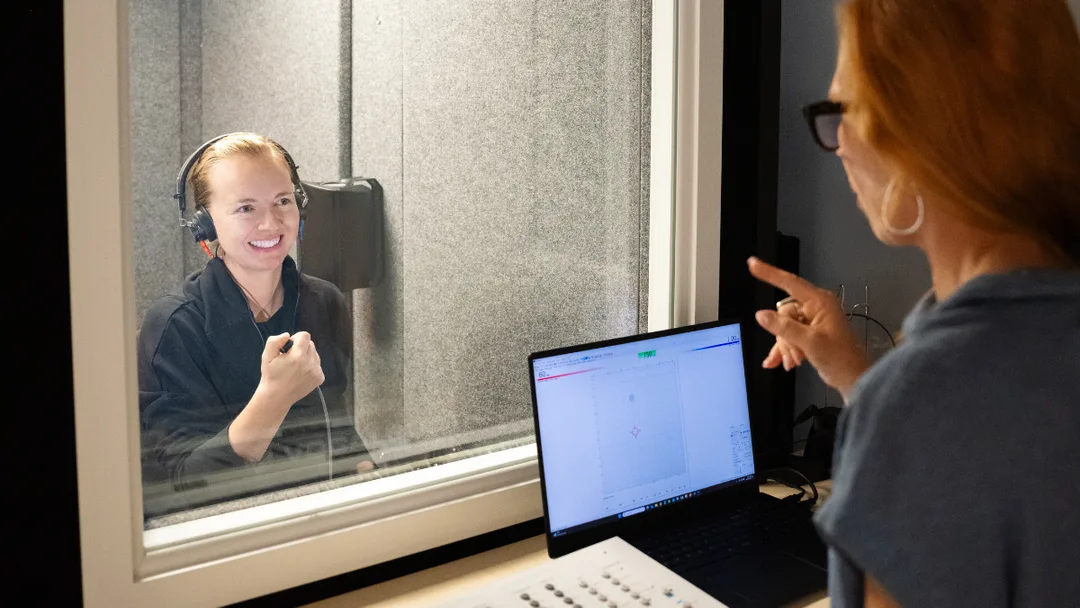
Your appointment is relaxed, unhurried, and takes about 45 minutes. Your audiologist explains every part of your audiogram in plain language, so you leave with real answers and a personalized plan.
- Medical Review
- Otoscopy
- Air and Bone Conduction Testing
- Speech Testing
- Speech-in-Noise
- Tympanometry
- Otoacoustic Emissions (OAEs)
Who Should Get Their Hearing Tested
You do not need to be struggling to keep up with conversation before a hearing evaluation makes sense. Difficulty hearing in noisy places, turning the volume up more than you used to, asking people to repeat themselves, or noticing a ringing in your ears are all reasons to get a clear baseline now. Adults over 50, anyone with a history of significant noise exposure, people taking medications known to affect the auditory system, and anyone with a family history of hearing loss are all good candidates for a diagnostic evaluation — not because something is definitely wrong, but because knowing where you stand gives you options. Children who are not meeting speech and language milestones, or who seem to miss sounds others catch easily, should be evaluated promptly. Your audiologist also sees parents navigating a recent diagnosis for their child, bringing both clinical expertise and personal experience to that conversation.
What Your Evaluation Involves
Every evaluation starts with a quick review of your health history, medications and family history. Then the core tests:
- Otoscopy — a quick, painless look inside the ear canal to rule out blockages or eardrum changes.
- Pure-tone air and bone conduction testing — finds the softest sounds you can hear across pitches, and where any loss begins.
- Speech testing — measures how clearly you recognize spoken words, including with background noise.
- Tympanometry — checks eardrum movement and middle-ear pressure.
When needed, your audiologist may add otoacoustic emissions or auditory brainstem response testing. Both simply require you to sit still.
How Your Audiologist Explains Your Results
Your audiogram is reviewed with you before you leave — not mailed to you later, not handed off to a coordinator. Your audiologist walks through every result in plain language, connecting the numbers on the page to the real-life situations you described when you arrived. If a pattern on your audiogram explains why crowded restaurants are harder than one-on-one conversations, you will hear it in those exact terms. The goal is that you leave understanding what your results mean, not just what category they fall into.
What Comes After Your Evaluation
A personalized care plan matched to your hearing profile and lifestyle is part of every evaluation at Ekho Audiology. If treatment is appropriate, you will hear the options clearly — what each one would actually change about the situations you told your audiologist about. If a watch-and-wait approach makes more sense, or if what you are experiencing has a straightforward explanation that does not require intervention, that is what you will be told. There is no pressure in any direction, because the point of a thorough evaluation is an honest answer, not a predetermined one.